

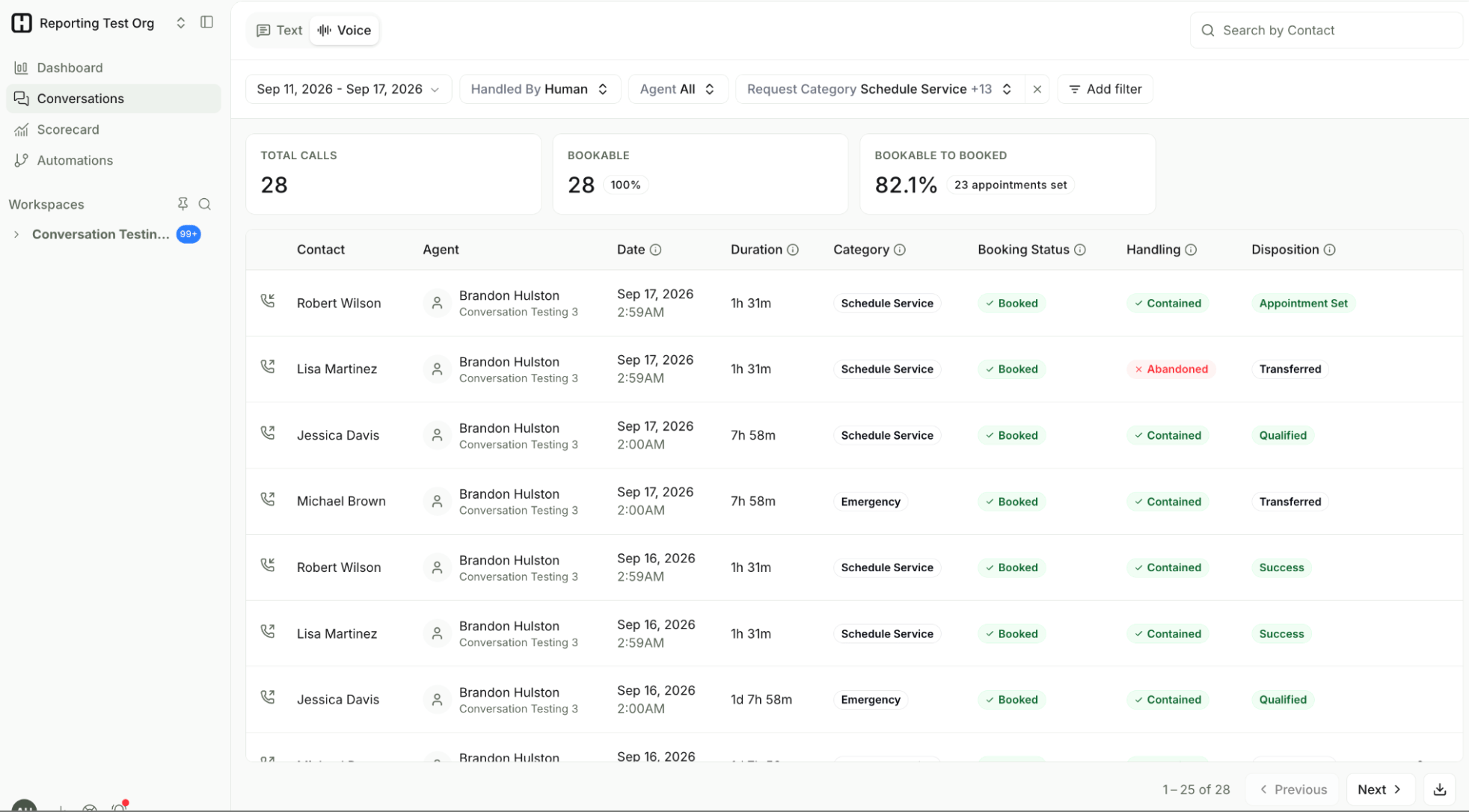
Metrics on the Conversations page
Every AI Voice call is labelled against four metrics.Category
Category
The caller’s primary intent during the call — what they actually rang up about.
Possible values: Schedule Service, Reschedule, Appointment Confirmation, Emergency, Technical Support, Billing Inquiry, Warranty, Cancellation, Quote Request, Transfer Request, Follow Up, Complaint, General Question, Spam, No Response, Other.
Booking Status
Booking Status
Whether the call should have produced a booking, and whether it did. This is a single status combining two underlying judgements: was the call bookable, and was it booked.
A call is bookable when a real customer calls in with a serviceable need and intent that the agent is configured to book. Calls from disqualified callers (for example, someone who isn’t the homeowner) and calls about job types the agent isn’t configured for (for example, emergencies or same-day work) are not bookable.
Possible values:
- Booked — the call was bookable and the agent completed the booking.
- Not booked — the call was bookable, but no booking was made. These are your missed opportunities, and the most useful calls to review.
- Not bookable — the call was never bookable in the first place, so no booking was expected. Nothing went wrong here.
If a calendar is not set up, “Booked” is based on the agent’s ability to confirm an appointment with the caller rather than on a real calendar write.
Handling
Handling
Whether your Voice AI agent handled the call on its own, handed it off, or never got the chance.
Possible values:
- Contained — the agent handled the call independently, start to finish.
- Transferred — the agent passed the call to a person or an external number. See Live Transfers.
- Abandoned — the contact ended the call before it reached a resolution.
Disposition
Disposition
The outcome label applied when the conversation closed. For an AI agent, this is simply the disposition configured on the /end commands in that bot’s instructions — so the values you see here are the ones your team set up.
See Dispositions in Hatch for how to manage the list, and Configuring Dispositions for reporting settings.
Scorecard metrics
These metrics appear on the Voice AI Scorecard rather than on the Conversations page. They go a level deeper — explaining why a bookable call didn’t book, and where in the call a handoff or hang-up happened.Not Booked Reason
Not Booked Reason
Why the agent didn’t book a call that was bookable. Hatch analyses every bookable call that didn’t result in a booking and groups them by reason, so you can see what’s actually costing you bookings rather than inferring it from a conversion rate.
Possible values:
- No Availability — the agent didn’t return any relevant times.
- Declined Availability — the caller rejected the availability the agent offered.
- Pricing — fees, or an issue with pricing.
- Human Requested — the caller asked for a human in the middle of being booked by the agent.
- Customer Gave Up — the caller abandoned the call and hung up.
- Tool Error — the agent hit a tool error (a lookup, the scheduler, and so on) that stopped the lead booking.
- Other
Handling Stage
Handling Stage
Where in the call a handoff or an abandonment happened — how far the conversation got before it stopped.
Possible values, in the order a call moves through them:
- Intake — the opening of the call, before anything has been established.
- Contact Confirmation — confirming who the caller is and their details.
- Issue Qualification — working out what the caller needs and whether it’s something the agent can serve.
- Task Resolution — handling a request that isn’t a booking.
- Scheduling — finding and confirming an appointment time.
- Completed — the call reached its end state.
Task Resolution and Scheduling are mutually exclusive — a call goes down one branch or the other after Issue Qualification, never both. So a call that handed off at Issue Qualification never progressed to either.
Handoff Classification
Handoff Classification
Why the call was transferred, and whether that handoff was working as intended or points at a gap in the agent’s setup.
Possible values:
- Escalated — the caller specifically asked for a human part-way through working with the agent.
- Qualified — the agent passed the lead off properly, exactly as configured. These calls are usually not bookable.
- Requested — the caller asked for someone at the very start of the call.
- No Handoff — there was no handoff.
Read this alongside Handling Stage. An agent configured to hand leads off will show a Qualified handoff at the Issue Qualification stage — that’s the system working as intended, not a failure.
Rates
Two aggregate rates roll up from the metrics above and are the quickest read on how an agent is performing.Bookable to Booked
Bookable to Booked
Containment
Containment
Related Articles
- Conversations Page: where these metrics appear, and how to filter by them.
- Voice AI Scorecard: where the Scorecard metrics live.
- How to Review Conversations: open a call, listen to the recording, and flag an issue.